The thing about first-world problems is that the moment you complain about anything remotely luxurious, somebody lobs the phrase “first-world problems” at your head as if they’ve delivered the final word in moral philosophy.
Bad service at a Michelin-starred restaurant in Mayfair? First-world problems.
Your Aston Martin has ludicrously expensive parts? First-world problems.
The caviar on your private jet isn’t quite cold enough? Well, yes, admittedly, that one probably deserves it.
And look fair enough. It is healthy that there remains some social mechanism to stop the privileged disappearing entirely into a fog of entitlement. Public mockery is, in many ways, the last defence against becoming unbearable.
But here’s the thing: being fortunate enough to enjoy something expensive does not mean one forfeits the right to be annoyed when that expensive thing is rubbish.
If anything, the opposite is true.
When you pay for premium, you are entitled to expect premium. Otherwise what exactly are you buying? If nobody complains, standards slip, mediocrity thrives, and before long you’re paying champagne prices for lemonade in a plastic cup.
And besides, a good rant is one of life’s great pleasures. British people, in particular, have elevated complaining to an art form somewhere between sonnet writing and minor warfare.
So, buckle up. Rant incoming.
Business class air travel is its own ecosystem, populated by four species.
First, the business traveller. These people know the game. They don’t waste time getting giddy about champagne at 35,000 feet. They eat in the lounge, board, recline the seat, sleep, and emerge eight hours later looking mildly irritated but operational, ready for some deeply important meeting involving phrases like “leveraging synergies.”
Second, the travel influencer. Endless numbers of them. Search “best business class” on YouTube and you’ll find an army of aggressively enthusiastic people filming themselves in airport lounges while grinning at miniature salt-and-pepper shakers. I strongly advise against doing this unless you want your social feeds clogged for eternity with dazzling veneers and people saying “Hey guys, welcome back to the channel” from seat 3A. I suspect one in three people on any long-haul flight is currently filming a cabin tour for Instagram.
Third, the bargain hunter. I rather admire these people. These are the pilgrims of premium cabins, endlessly gaming routes and fare classes until they discover they can fly business to Madrid for “just a little more than economy” provided they route via Bangkok, Nairobi and the moon. There is something heroic about that sort of determination.
Fourth, the rich. The genuinely rich are not travelling business class so much as tolerating it because the private jet is unavailable and there wasn’t first class. They regard business class the way the rest of us regard the back seat of an Uber.
On this trip, I found myself inhabiting categories one, two and three simultaneously: travelling for work, delighted by a good deal, and, yes, writing about it. Which I suppose is influencer-adjacent, albeit without the whitened teeth.
So there I was, flying Etihad business class from Hong Kong to London via Abu Dhabi.
And before anyone starts muttering “first-world problems,” let me point out that I paid extra for the privilege of choosing my seat.
That phrase alone should set alarm bells ringing.
Because somewhere along the line, airlines have quietly decided that buying a premium ticket no longer entitles you to a premium experience. You now have to pay extra for the things that used to define the cabin in the first place.
This is the Ryanair-ification of everything.
Etihad, with a straight face, offers tiers within business class. “Business Value.” “Business Comfort.” Presumably followed eventually by “Business We Quite Like You” and “Business Emperor.”
But business class is the tier.
The tiers are already there: economy, premium economy, business, first. That is enough tiers. We do not need business class subdivided like cuts of beef.
Still, I paid for Business Comfort, lured by the promise of added benefits.
These “benefits,” incidentally, included lounge access, of no use whatsoever when your connection is so tight you’re sprinting through the airport like a man escaping an international incident.
It also included chauffeur service, but only in the UAE, and since I never actually left transit, there was no opportunity for a man in gloves to whisk me anywhere in a black Mercedes while calling me “sir.”
So in practical terms, the only real benefit I paid for was seat selection.
Fine. I selected my seat.
The first leg from Hong Kong was absolutely splendid in the sense that the seat I booked was, astonishingly, the seat I was given. Aviation innovation at its finest.
Then came the second leg.
Somewhere between landing and boarding, my carefully selected seat (10k) vanished. No explanation. No apology. Just gone.
In its place: 26E.
Now, if you are unfamiliar with the geography of an aircraft cabin, 26E sounds innocuous enough. It sounds like a seat.
It is not a seat.
It is a punishment.
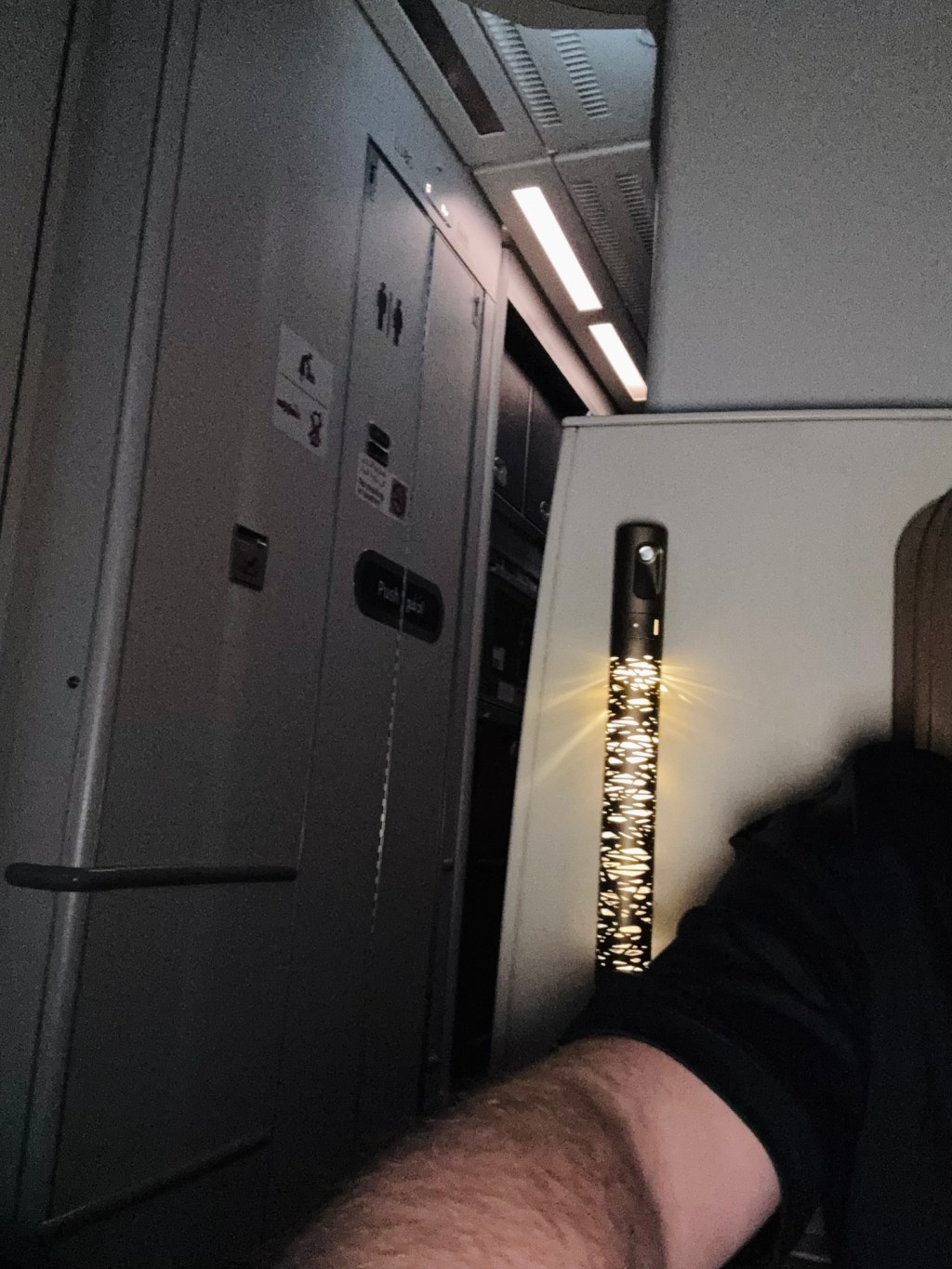
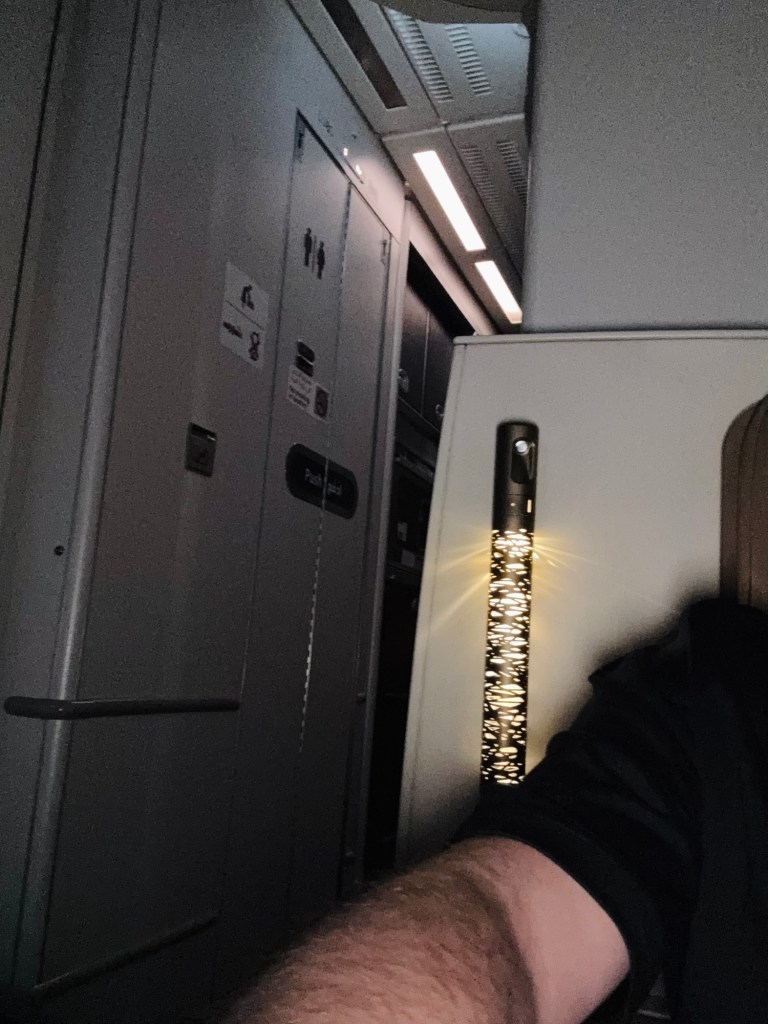
It is at the very back of the business-class cabin, wedged beside the toilets, flanked by enormous aircraft doors, with the galley behind and a steady stream of humanity wandering past at all hours.
The crew bustle by constantly. Doors loom ominously at either side. Lavatories hiss and clunk in stereo. The smell drifts over intermittently like an unwelcome reminder that luxury, in this instance, is merely decorative.
Instead of feeling like a premium passenger, I felt like I’d been assigned a folding chair in the backstage service corridor.
There are seats in business class where you feel cocooned in privacy.
And then there is 26E, where you feel like a nightclub toilet attendant.
The window seats on Etihad are superb, private, sleek, cleverly arranged.
But the rear centre seats? Good grief.
Seat row 24 on the A380 places you between giant aircraft doors, as if you are moments away from being asked to “cross your arms and prepare to jump.”
Seat row 25 has you facing a queue of people waiting for the lavatory, allowing you the unique premium experience of making awkward eye contact with strangers clutching toothbrushes.
And seat row 26?
Seat row 26 is where dreams go to die.
The combined soundtrack of flushing toilets and clattering meal carts is so relentless that you begin to feel you’re working in the galley rather than travelling in business class.
And the most maddening part?
Nobody could explain why.
Not the gate staff. Not the cabin crew. No one.
The seat I paid for was gone, replaced by something objectively worse, and everyone simply shrugged in the universally infuriating language of airline indifference.
This is what really rankles: not the bad seat, but the utter absence of accountability.
If you charge people extra for seat selection, then the least you can do is honour it, or explain why you haven’t.
Otherwise, what exactly was I paying for?
Not comfort.
Not certainty.
Apparently not even the seat.
So yes, go on. Say it.
“First-world problems.”
Of course it is.
But if I pay for business class and end up dining, sleeping and existing next to two lavatories and a trolley depot, I reserve the right to complain.
Because not all seats are equal.
And on Etihad, they are wildly unequal.
 The Travel Critic
Leave a comment