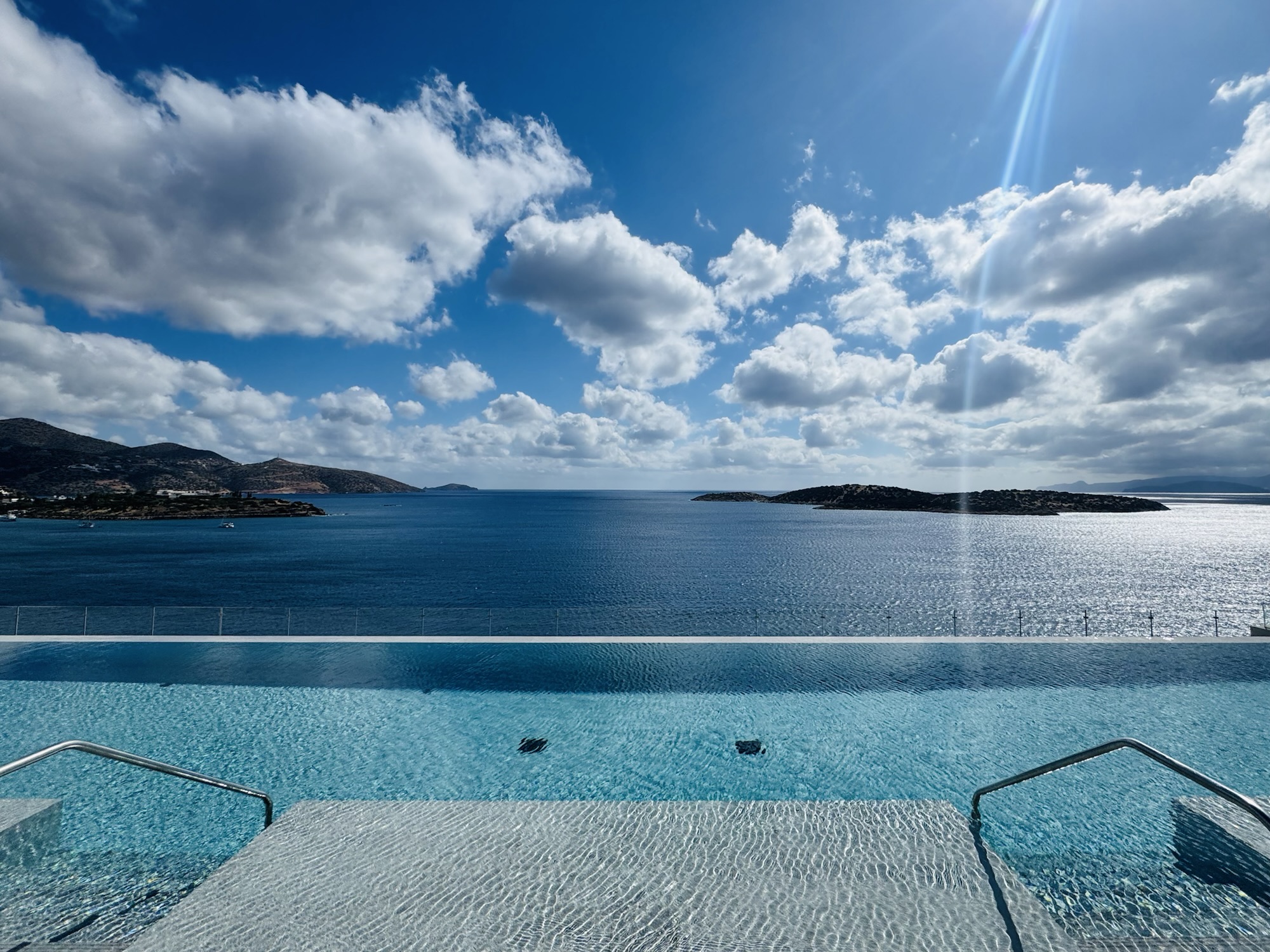
The InterContinental Crete arrives like a supermodel walking into a beach club. Heads turn. Conversations stop. Everyone notices.
And for the first couple of days, you completely understand why.
This is an exceptionally handsome hotel. It occupies a glorious position above the sea, with views so perfectly framed they look less like scenery and more like expensive marketing materials. The lobby is full of oversized art and even larger architectural ambitions. Everything feels polished, deliberate and expensive.
The rooms continue the story. Modern, fresh and luxurious without becoming gaudy. The shower deserves a special mention: powerful, hot and reliable, which sounds like faint praise until you’ve spent enough time in luxury hotels to know that a truly excellent shower is rarer than it should be.
The staff, meanwhile, are superb. Warm, efficient and consistently helpful. In particular, the breakfast team possess an almost supernatural ability to get coffee to your table. No matter how busy things become, caffeine arrives with impressive speed and cheerful competence.
But somewhere around the 48-hour mark, you begin to notice that beauty alone isn’t always enough.
Breakfast is where the cracks first appear. InterContinental breakfasts are normally one of the highlights of the brand. They’re usually occasions. Here, it feels more like a very well-run canteen. Lots of tables. Most of them occupied. Long lines of food waiting to be collected. The staff work incredibly hard, but the experience itself lacks theatre.
Most disappointing is the absence of a fresh egg station. Instead, there are large bowls of scrambled eggs sitting among the buffet offerings. How long have they been there? Nobody says. I have my theories.
The pools are another example of style winning a narrow victory over practicality.
There are two of them, one on the fifth floor and another on the ninth. The views are spectacular. Properly spectacular. The sea stretches endlessly towards the horizon and, particularly from the upper pool, it’s difficult not to spend several minutes staring out at it and wondering why you don’t live somewhere warmer.
The problem is capacity. There simply aren’t enough loungers for the number of guests who seem to want them. As a result, chairs become sunbeds by necessity rather than design.
Then there are the towels. Not pool towels, room towels. The system appears to be that you take your room towels to the pool. Fair enough. Except housekeeping only replaces them when they’re actually in your room. Which means that sooner or later you’re wandering the hotel actively trying to source fresh towels like some sort of luxury-resort scavenger hunt. It’s not a catastrophe. It’s simply the sort of tiny operational detail that a truly great hotel would have solved.
The lifts are also permanently busy enough that I found myself taking the stairs more often than not. Good for my fitness, perhaps. Less good for a hotel of this calibre.
And that’s really the story of the InterContinental Crete.
The location is perfect. The views are extraordinary. The staff are excellent. The rooms are stylish. The shower is magnificent.
If I weren’t a regular traveller and a fan of the InterContinental brand, I’d probably spend the entire stay marvelling at how beautiful the place is. Most guests undoubtedly will.
But the best luxury hotels aren’t remembered because they’re beautiful. They’re remembered because they’ve obsessed over the details you never have to think about.
The InterContinental Crete gets almost everything right. It just occasionally feels as though it stops one step short of greatness.
It’s a supermodel hotel. Stunning to look at, impossible to ignore, and just occasionally you find yourself wishing for a little more personality behind the perfect face.
And before any actual supermodels write in, this is obviously a joke. I’m sure you’re all fascinating conversationalists with impeccable towel-management systems.


Leave a Reply